
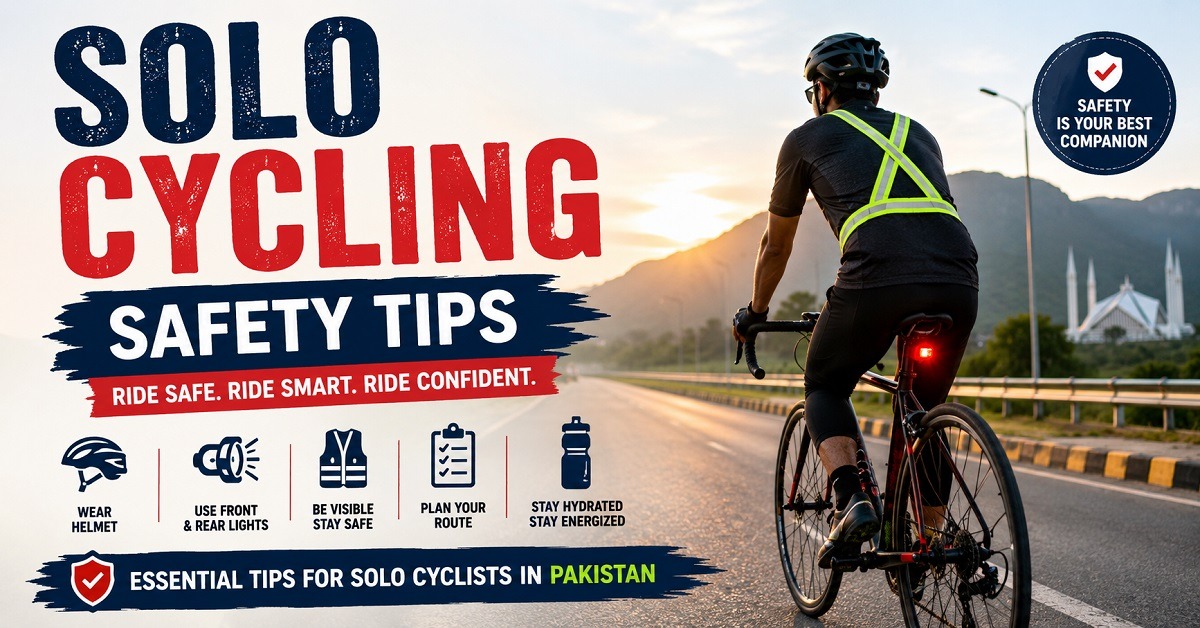
Solo cycling can be one of the best ways to explore Pakistan, stay active, commute to work, or simply enjoy some peaceful time on your bicycle. But riding alone also means you are responsible for your own navigation, visibility, bicycle condition, and emergency planning.
Whether you are cycling through the streets of Karachi, Lahore, Islamabad, Rawalpindi, Faisalabad, Peshawar, Multan, or taking your bicycle onto quieter roads outside the city, a little preparation can make your ride considerably safer.
In this guide, we’ll cover practical solo cycling safety tips, essential cycling gear, road safety advice, what to carry, how to plan your route, and what Pakistani cyclists should know before heading out alone.
Table of Contents
Quick Summary: Solo Cycling Safety Checklist
| Safety Item | Why It Matters | Recommended |
|---|---|---|
| Cycling helmet | Protects your head during a crash | Essential |
| Front light | Helps you see and be seen | Essential at night |
| Rear light/reflector | Makes you visible from behind | Essential at night |
| Reflective clothing | Improves visibility | Highly recommended |
| Bell | Alerts pedestrians and traffic | Recommended |
| Mobile phone | Emergency communication/navigation | Essential |
| Water bottle | Prevents dehydration | Essential |
| Basic repair kit | Handles punctures and minor problems | Recommended |
| ID/emergency contact | Useful during emergencies | Recommended |
| Route sharing | Lets someone know where you are | Highly recommended |
Pakistan’s National Highways & Motorway Police safety guidance specifically advises cyclists to keep their bicycles in good mechanical condition, use cycle paths where available, ride along the left edge where there is no cycle track, ride in single file, follow traffic signals, and use a white front light and visible rear reflector at night.
1. Plan Your Route Before Leaving
One of the most important solo cycling safety tips is to know where you are going before you start riding.
Avoid simply getting on your bicycle and deciding your route as you go, particularly when riding alone. Check the route on your phone before leaving and identify:
- Busy roads
- Major intersections
- Areas with heavy truck traffic
- Road construction
- Narrow roads
- Steep climbs or descents
- Fuel stations or shops
- Hospitals and emergency facilities
- Places where you can stop safely
Whenever possible, choose roads with lower traffic volume and better road surfaces.
If you are cycling in a city such as Karachi or Lahore, service roads and quieter residential routes may sometimes be preferable to major highways. However, always follow local traffic rules and use designated cycling infrastructure where available.
Expert Tip
Don’t judge a route only by distance.
A 15-kilometre route with heavy traffic can be considerably more challenging than a 20-kilometre route using quieter roads.
2. Tell Someone Where You Are Going
When cycling alone, someone should know your basic plan.
Before leaving, send a family member or friend:
“I’m going cycling from [starting point] to [destination]. I expect to return around [time].”
For longer rides, consider sharing your live location through a trusted messaging app such as WhatsApp etc.
You don’t need to make this complicated. The goal is simply to ensure that someone knows where you are if your phone stops working, your bicycle breaks down, or you don’t return when expected.
This is especially important for long-distance cycling, rural routes, early-morning rides, and unfamiliar areas.
3. Always Wear a Proper Cycling Helmet
A helmet should be one of your first purchases if you regularly ride a bicycle.
The CDC states that wearing a helmet while riding a bicycle can save lives.
When buying a helmet, look for:
- Correct size
- Adjustable retention system
- Secure chin strap
- Good ventilation
- Comfortable fit
- Appropriate safety certification
- Adequate coverage
A helmet should sit firmly on your head without moving excessively when you shake your head.
Don’t buy a helmet simply because it looks attractive. Safety, fit and comfort should come first.
Pakistan Helmet Price Range
Basic cycling helmets in Pakistan can start around Rs. 1,200–1,500, while better-quality branded or feature-rich helmets can cost considerably more.
For example, current online Pakistani listings show basic adult cycling helmets around Rs. 1,500, although prices vary by seller, brand, quality and availability. Check latest Cycling Helmets listed at Cycling Equipments.
4. Make Yourself Visible
Visibility is extremely important when cycling alone.
Many bicycle accidents happen because motorists or other road users don’t notice cyclists early enough.
Wear:
- Bright-coloured clothing
- Reflective strips
- Reflective vest when appropriate
- Reflective accessories
- Light-coloured clothing at night
The CDC also recommends improving visibility with bright and reflective clothing and using lights when it is dark.
Pakistan’s road-safety guidance also recommends reflective equipment and light-coloured clothing for better visibility.
Don’t Rely Only on Reflectors
Reflectors work when illuminated by vehicle headlights, but active bicycle lights are a better choice for night riding.
Use a white front light and a red rear light or clearly visible rear reflector.
📖 Read Also:
DIY Bike Service at Home: A Complete Beginner’s Guide for Cyclists in PakistanThis guide explains everything beginners need to know about DIY bicycle servicing at home, including the tools you’ll need, how much they cost in Pakistan, and step-by-step maintenance procedures.
5. Use Front and Rear Bicycle Lights
If you regularly cycle early in the morning, after sunset or at night, bicycle lights should be considered essential equipment.
A front light helps you:
- See potholes
- Identify road hazards
- See pedestrians
- Improve your visibility
- Navigate poorly lit roads
A rear light helps approaching motorists identify you from behind.
Pakistan’s National Highways & Motorway Police guidance specifically calls for a white light at the front and a clearly visible rear reflector when riding at night.
Pakistan Bicycle Light Price Range
Basic front-and-rear bicycle light sets can currently be found online for roughly Rs. 500–1,500, while rechargeable and higher-output lights can cost more.
For example, current Pakistani listings include basic front/rear LED sets around Rs. 549–560 and rechargeable front lights around Rs. 1,550.
Prices change frequently, so treat these figures as an indicative range rather than a fixed market price. Check out the best selling bicycle lights available on Cycling Equipments.
6. Keep Your Bicycle Mechanically Ready
Before every solo ride, spend two or three minutes checking your bicycle.
Use the simple ABC check:
A — Air
Check both tyres.
Look for:
- Low pressure
- Visible punctures
- Cracks
- Damaged tyre sidewalls
B — Brakes
Squeeze both brake levers before starting.
Make sure the brakes respond properly and don’t feel excessively loose.
C — Chain and Components
Check that:
- The chain is moving correctly
- Wheels spin normally
- Quick releases or thru-axles are secure
- Handlebar is tight
- Saddle is secure
- Lights are working
- Bell works
Pakistan’s National Highways & Motorway Police specifically advises cyclists to make sure the bicycle is in good mechanical condition, particularly the brakes and tyres.
7. Carry a Basic Bicycle Repair Kit
A solo cyclist should never assume that the bicycle will remain problem-free.
For longer rides, carry:
- Spare inner tube
- Tyre levers
- Mini pump
- Multi-tool
- Puncture repair kit
- Chain quick link if appropriate
- Small amount of cash
- Power bank
You don’t need a large toolbox.
A compact saddle bag or frame bag can carry most of these items.
If you don’t know how to repair a puncture yet, learning this skill should be one of your priorities as a cyclist.
8. Carry Your Phone — But Don’t Use It While Riding
Your smartphone can be extremely useful during a solo ride.
Use it for:
- GPS navigation
- Emergency calls
- Location sharing
- Checking weather
- Finding nearby shops
- Finding medical facilities
- Contacting family
But don’t hold your phone while cycling.
If you need to check navigation, stop somewhere safe first.
Even a few seconds of distraction can cause you to miss a pothole, pedestrian, motorcycle or vehicle.
📖 Read Also:
Cycling for Students in Pakistan: Benefits, Safety Tips, and Complete GuideFor students in Pakistan, learn how riding a bicycle can make daily life easier while improving physical fitness, mental well-being, and academic performance.
9. Choose the Right Time to Ride
Pakistan’s weather can have a major impact on cycling safety.
During extremely hot weather, avoid the hottest part of the day whenever possible.
Early morning can be a comfortable option, while evening rides can also work if you have adequate lighting and visibility.
During summer:
- Carry sufficient water
- Wear breathable clothing
- Use sunscreen
- Take regular breaks
- Avoid prolonged exposure to extreme heat
During monsoon or rainy weather, be particularly careful around:
- Standing water
- Mud
- Slippery surfaces
- Open drains
- Broken roads
- Reduced visibility
Never assume that a familiar road is safe after heavy rain.
10. Ride Defensively Around Traffic
One of the most important bike safety tips is to assume that other road users may not see you.
Watch carefully for:
- Motorcycles overtaking closely
- Cars changing lanes
- Vehicles opening doors
- Buses pulling away from stops
- Cars turning across your path
- Pedestrians stepping into the road
- Parked vehicles
- Unexpected U-turns
Maintain a predictable riding line and communicate your intentions clearly.
Pakistan’s cycling safety regulations advise cyclists to give proper signals before changing course or turning and to follow traffic signs and signals.
11. Avoid Blind Spots
Never assume a large vehicle driver can see you.
Stay particularly cautious around:
- Buses
- Trucks
- Trailers
- Delivery vehicles
- Large vans
If you cannot see the driver’s mirrors, there is a good chance the driver may not be able to see you.
When in doubt, slow down and create distance.
12. Don’t Listen to Loud Music
Cycling with headphones can reduce your awareness of approaching vehicles, motorcycles, horns and other hazards.
If you want to listen to something while riding, keep the volume low enough to remain aware of your surroundings.
For solo cycling on busy Pakistani roads, being able to hear what is happening around you is far more valuable than having loud music playing.
📖 Read Also:
How to Build a Cycling Habit: A Complete Guide for Beginners in PakistanIn this guide, you’ll learn practical strategies that work for beginners in Pakistan, along with expert advice to help you stay motivated throughout your cycling journey.
13. Carry Water and a Small Snack
Dehydration can turn a pleasant ride into a serious problem.
Always carry enough water for your planned distance and weather conditions.
For longer rides, consider carrying:
- Dates
- Banana
- Energy bar
- Sandwich
- Electrolyte drink
Don’t wait until you feel extremely thirsty before drinking.
14. Be Careful With Rural and Isolated Routes
Beautiful roads outside major cities can be excellent for cycling, but isolated routes require additional preparation.
Before heading into a remote area:
- Tell someone your route.
- Download or prepare offline navigation.
- Carry enough water.
- Carry a repair kit.
- Fully charge your phone.
- Carry a power bank.
- Check the weather.
- Know where you can get help.
- Avoid riding after dark.
- Don’t take unnecessary shortcuts through unfamiliar areas.
A solo cyclist should always have a simple backup plan.
15. Keep Emergency Information With You
Consider carrying a small card containing:
Name:
Emergency Contact:
Blood Group:
Important Medical Information:
Phone Number:
You can keep this card inside your wallet, cycling bag or phone case.
You can also use an emergency contact feature on your smartphone if available.
What Cycling Safety Gear Should You Buy?
If you’re building your safety kit from scratch, you don’t need to purchase everything at once.
Prioritize your purchases.
| Gear | Priority | Approx. Pakistan Price |
| Cycling helmet | Essential | Rs. 1,200–5,000+ |
| Front/rear lights | Essential for night | Rs. 500–2,000+ |
| Reflective vest | Highly recommended | Rs. 500–1,500+ |
| Mini pump | Recommended | Rs. 500–2,000+ |
| Puncture repair kit | Recommended | Rs. 300–1,000+ |
| Bicycle bell | Recommended | Rs. 200–800+ |
| Multi-tool | Recommended | Rs. 700–3,000+ |
| Saddle/frame bag | Useful | Rs. 500–2,500+ |
| Phone holder | Optional | Rs. 500–2,000+ |
These are indicative Pakistan market ranges, not fixed prices. Brand, quality, material, features and seller can significantly affect the final price.
📖 Read Also:
Daily Cycling Routine for Beginners – Complete Guide for Pakistani CyclistsFor beginners, starting with a proper daily cycling routine is important. Many new cyclists make the mistake of riding too much too soon. Read this blog post to learn more…
Buying Tips for Solo Cycling Safety Gear
When shopping for cycling equipment, avoid choosing the cheapest product simply because it is inexpensive.
Instead, consider:
1. Safety First
For helmets and visibility equipment, prioritize safety and reliability.
2. Correct Fit
A poorly fitting helmet or uncomfortable accessory may become difficult to use consistently.
3. Weather Resistance
If you regularly ride in rain or humid conditions, consider water-resistant lights and bags.
4. Rechargeable Lights
Rechargeable lights can be convenient for frequent cyclists and reduce the need to replace batteries.
5. Spare Batteries or Power
For longer rides, don’t depend on a light or phone with a nearly empty battery.
6. Shop From Trusted Sellers
Check product specifications, seller ratings, reviews and return policies before purchasing.
You can also explore cycling products, accessories and safety equipment through Cycling Equipments, Pakistan’s cycling-focused marketplace.
Expert Tips for Solo Cyclists
Here are a few simple habits that experienced cyclists can use to improve safety:
Start with a short route.
If you’re new to solo cycling, don’t begin with a 70-kilometre ride.
Ride predictably.
Avoid sudden movements and unnecessary lane changes.
Slow down at intersections.
Intersections are among the places where you need maximum attention.
Don’t race traffic.
If a vehicle is approaching quickly, let it pass rather than trying to compete for road space.
Keep both hands available.
Pakistan’s road-safety guidance advises cyclists to keep both hands on the handlebar except when signalling.
Avoid unnecessary risks.
You don’t need to prove how fast or fearless you are.
Trust your instincts.
If an area or route feels unsafe, turn around or choose another road.
Check your bicycle after every major ride.
Small problems are easier to fix at home than on an isolated road.
A Simple Solo Cycling Checklist
Before leaving home, ask yourself:
☐ Is my helmet fitted correctly?
☐ Are my tyres properly inflated?
☐ Are my brakes working?
☐ Is my chain okay?
☐ Are my front and rear lights working?
☐ Is my phone charged?
☐ Did I tell someone my route?
☐ Do I have enough water?
☐ Do I have emergency cash?
☐ Do I have a repair kit?
☐ Have I checked the weather?
☐ Do I know my route home?
If the answer is yes to all of these, you’re much better prepared for your ride.
Frequently Asked Questions
Is solo cycling safe in Pakistan?
Solo cycling can be safe when you choose appropriate routes, follow traffic rules, use safety equipment, maintain your bicycle and tell someone about your route. Safety conditions vary significantly between cities, roads and times of day, so cyclists should use their judgement.
What should I carry when cycling alone?
At minimum, carry a charged mobile phone, water, some cash, identification, and basic repair equipment. For longer rides, add a spare tube, pump, multi-tool, snacks and power bank.
Do I need a helmet for cycling?
A helmet is strongly recommended for bicycle riding. Choose a properly fitting cycling helmet rather than a generic hard hat or construction helmet.
What lights do I need for night cycling?
Use a white front bicycle light and a red rear light or clearly visible rear reflector. Pakistan’s National Highways & Motorway Police guidance specifically mentions a white front light and rear reflector for night cycling.
What is the safest time for solo cycling?
There is no single safest time for every location. In hot parts of Pakistan, early morning can help avoid extreme daytime heat. For evening or night rides, choose well-lit routes and use appropriate front and rear lights.
Should I use headphones while cycling?
It is better to avoid loud music or anything that prevents you from hearing traffic and your surroundings. Situational awareness is particularly important when riding alone.
How can I stay safe while cycling on busy roads?
Ride predictably, remain visible, maintain a safe distance from vehicles, use signals, watch for turning traffic and avoid blind spots around buses and trucks.
What should I do if my bicycle breaks down during a solo ride?
Move yourself and the bicycle to a safe location away from traffic. Use your repair kit if you can safely make the repair. If the problem cannot be fixed, contact someone you trust or arrange transport rather than continuing to ride in an unsafe condition.
Conclusion
Solo cycling gives you freedom, fitness and the opportunity to discover Pakistan at your own pace. But riding alone requires more preparation than riding with a group.
The most important solo cycling safety tips are simple: wear a properly fitted helmet, make yourself visible, use front and rear lights when necessary, check your bicycle before every ride, choose safer routes, carry water and basic repair equipment, follow traffic rules, and let someone know where you’re going.
You don’t need expensive equipment to become a safer cyclist. Good habits, proper planning and awareness are often more valuable than expensive accessories.
Before your next ride, take a few minutes to prepare your bicycle, check your route and pack your essentials.
Ride smart, stay visible, and enjoy the journey.
For cycling equipment, accessories, bicycles and cycling-related products in Pakistan, explore Cycling Equipments — Pakistan’s Ultimate Cycling Marketplace.
Discover more from Cycling Equipments Pakistan
Subscribe to get the latest posts sent to your email.